
The World Cup
The World Cup is what all 32 national teams are actually building toward, whether they're run by an elected manager or left to the game's own AI. It's a two-stage competition: a long qualifying phase that thins the field, and a tournament proper with a familiar shape once you're through.
Qualifying comes first
Before there's a tournament, there's qualifying, and it isn't a quick formality. All 32 nations are seeded into eight groups of four, and each group plays a double round-robin: six matches per nation, split into two separate windows spread across the two-season election cycle. The first batch of matchdays runs early, once a freshly elected national team manager has had a few days to actually put a squad together; the second batch follows roughly a season later. Qualifying doesn't run on a separate track per nation either. Every group plays through the same shared windows at the same time, whether that nation is run by an elected manager or left to the game's own AI.
The tournament is built once qualifying finishes
Once every qualifying group has been resolved, the World Cup tournament is created for that cycle with the 16 nations that made it through. There's no partial tournament running alongside unfinished qualifying groups; the 16-team bracket only comes into existence once the full picture is settled.
Group stage, then knockout
The 16 qualified nations are split into 4 groups of 4, and each group plays a single round-robin, everyone facing everyone else in their group once. From there it moves into a straight knockout bracket: Quarter-Final, Semi-Final, Final. No group safety net once you're through, one round, one result, next round. A knockout match still level after ninety minutes goes to extra time, and to penalties if it's still level after that, the same escalation the Elite Champions Cup's own knockout rounds use.
What happens to everything else during an international break
While World Cup matches are actually being played, an international break can pause your club's league and cup match simulation specifically, so international football doesn't get squeezed in around a normal domestic week. Nothing else on the world clock stops for it: finances keep processing, the transfer market keeps resolving bids, scouting missions keep running, injuries keep recovering, and friendlies carry on as normal, since they carry no competitive weight of their own and there's nothing about them an international window needs to protect. Only league and cup fixtures step aside to make room.
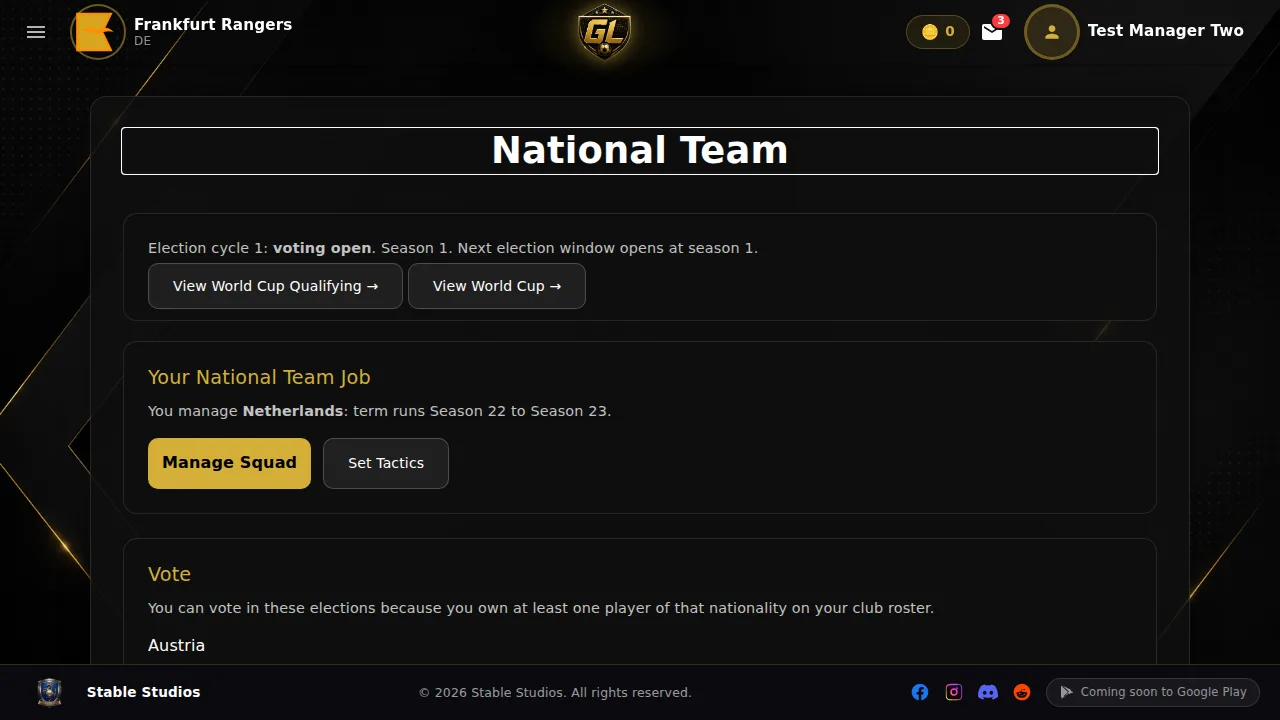
You don't need to be running a national team yourself to watch any of this unfold. Qualifying standings and the tournament bracket are visible from the National Team hub regardless of whether you hold an elected job anywhere, so following along is open to every manager, not just the ones currently in charge of a country.
Sitting alongside your club season
None of this replaces your club's calendar, it just borrows a slice of it. The rest of the time your club keeps playing through its own league season and cup rounds on the usual fixture schedule, and a World Cup cycle runs on its own two-season clock, independent of any single country's own promotion or relegation picture. The one place the two calendars visibly meet is right where an international break opens: your club's fixture list simply goes quiet for its duration, then picks back up exactly where it left off once the break closes.