
Player Attributes Explained
Open any player's profile and there's a lot to look at: a run of technical stats, a separate set for goalkeepers, a handful of traits that never move no matter how much training a player gets, a full career record, and a couple of numbers that shift week to week. None of it is decorative. This page walks through what each one actually is and where it comes from.
Technical attributes
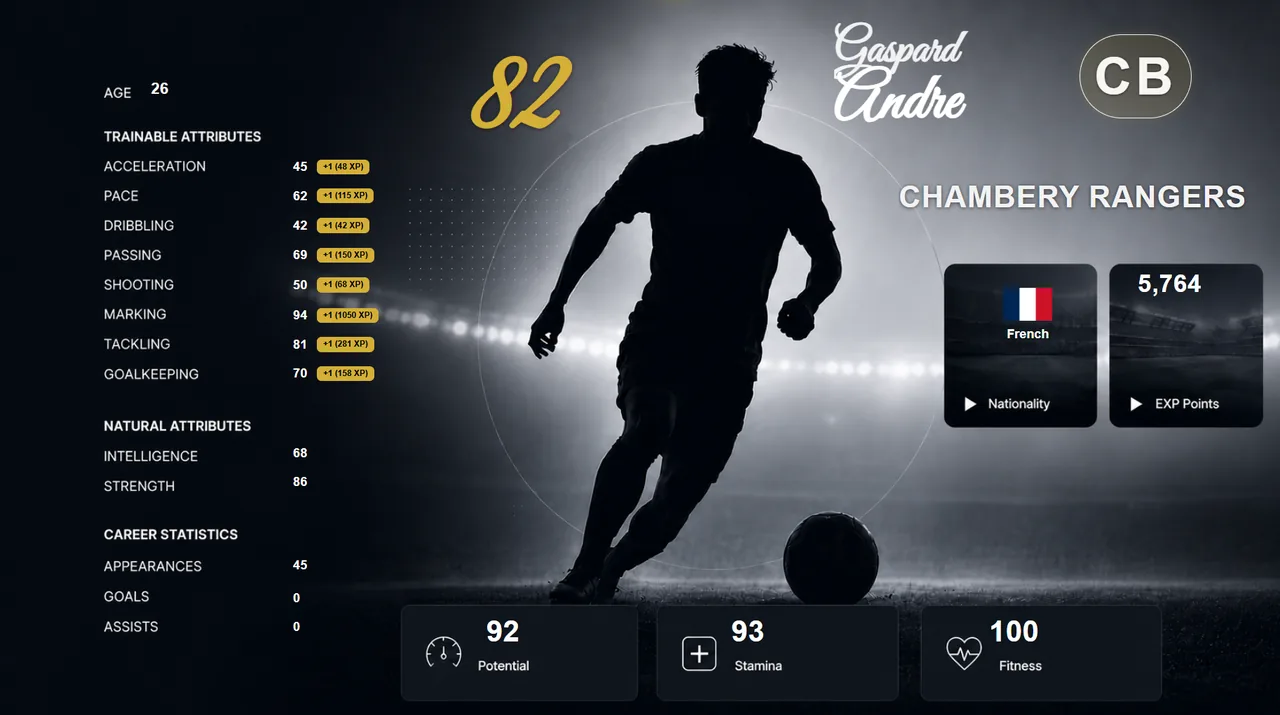
Eight stats sit under the technical heading, and every one of them is trainable: Acceleration, Pace, Dribbling, Passing, Shooting, Heading, Marking and Tackling. These are outfield fundamentals, the kind of thing a coach works on rather than something a player simply arrives with. A player's technical numbers describe what they can currently do on the ball or against an opponent, and they change as a player develops.
Goalkeeping attributes
Three more trainable stats belong specifically to goalkeepers: Reflexes, Handling and Positioning. Reflexes covers a keeper's reaction in the instant a shot is struck, Handling covers what happens once the ball actually reaches them, and Positioning covers how well they read where to be before it arrives. They train the same way the outfield technical stats do, on the same underlying system, they're just specific to the one position that needs them.
Natural attributes
Four stats sit apart from the rest and don't train at all: Intelligence, Composure, Strength and Stamina. These are treated as fixed traits a player already has rather than something a training ground can build up. Unlike the technical stats, they carry no penalty when a player lines up outside their natural position, because they aren't tied to a specific role on the pitch the way passing or tackling is.
Height
Every player has a height in centimetres, set when they arrive in the game and never changing. It isn't an attribute: it doesn't train, doesn't count towards Overall and doesn't change a player's transfer value. It only shows up in the moments where it would in real life. Taller players win more headers at corners and crosses, and a tall keeper reaches more high balls. Shorter players are nimbler on the ball, harder to stop when they dribble and quicker to get a shot away, and a big defender turns slower against them. Keep an eye on the commentary: a really tall or really short player now and then gets a mention when their height decides a moment.
Overall, Potential, Fitness and Form
Overall is a single summary number, everything above compressed into one figure. Potential is a separate number entirely, a ceiling a player can still grow toward rather than a measure of where they stand today. A young player's Overall and Potential can sit a long way apart, and closing that gap over time, alongside a growing pool of ExperiencePoints, is what development is for.
Fitness and Form are the two numbers on a player card that move week to week instead of growing across a career. Fitness runs from 0 to 100 and tracks how much a player has actually been playing, coming down with minutes on the pitch and recovering with rest. Form starts every player at 50 and drifts up or down with how their recent performances have gone, a running read on how a player is playing right now rather than a fixed rating of how good they are.
How Experience Points actually get earned
Every player earns Experience Points from playing, and not just from league fixtures. A league match earns the full amount; a Domestic Cup or Elite Champions Cup match earns half that, still a real contribution rather than nothing. Getting substituted on or off partway through a match doesn't zero out what a player earns either, Experience Points scale with the actual minutes played, so a late cameo off the bench is still worth something, and coming off early doesn't waste the minutes already put in.
On top of match XP, every player also earns a small amount simply for time passing in the real world, whether they've been selected that day or not. It's a modest trickle rather than a substitute for actually playing them, but it means a squad player kept out of the XI is never completely stuck in place.
Banked Experience Points get spent from a player's profile page to train a specific attribute up by one point at a time. The cost per point rises the higher that attribute already is, gently at first and steeply once you're pushing a player toward the very top of their range, so an early point is cheap and a genuinely maxed-out stat is a long-term project. The Training Complex speeds up the whole pipeline, adding a percentage boost to Experience Points earned that grows with its own level.
The rest of the player record
A career is tracked in full: Appearances, Goals, Assists, Yellow Cards, Red Cards and Clean Sheets, kept both as a lifetime total and broken out for the current season alone, so a good run of form this year is never buried inside a whole career's number.
- A Weekly Wage and a Transfer Value, both set by the club and the market rather than typed in by hand.
- A Squad Number, and one free rename a manager can spend on that player, ever, after which the option is gone for good.
- A retirement flag, set a season ahead of time when a player is due to hang up their boots, so you always get a full season's notice before they're actually gone.