
Injuries, Fitness & Suspensions
A squad that looks fine on paper can still be unavailable on matchday for three completely different reasons: a player is tired, a player is hurt, or a player is banned. Goal Legends tracks all three separately, and they behave differently enough that it's worth knowing which one you're actually looking at.
Fitness
Fitness is a number from 0 to 100 that moves with what a player actually does. Playing matches brings it down, rest brings it back up. It's the most ordinary of the three states here: nothing dramatic happens to a tired player, they're just less available than a fresh one, and fitness recovers on its own over time without you having to do anything.
Injuries
An injury is different from low fitness in a way that matters: it's tracked against the real calendar, not the number of matches played. An injured player has a return date attached to them, and a short description of what's actually wrong, and they're unavailable until that date arrives regardless of how many fixtures your club plays in the meantime. A club with a packed cup and league schedule doesn't get an injured player back any faster than one with a quiet week, because the clock running is the real one, not the fixture list.
Suspensions
A suspension is measured the opposite way: in matches missed, not calendar time. Enough yellow cards in a season, or a red card, and a player sits out a set number of upcoming matches regardless of how long that takes in real days. A suspended player two weeks into a break from fixtures is still suspended when those fixtures resume, exactly where they left off.
Club discipline and national team discipline don't mix
Yellow cards and suspensions picked up playing for your club and yellow cards and suspensions picked up playing for a national team are tracked as entirely separate counts. A player serving out a suspension for your club is still available to be selected for their country, and a suspension picked up on international duty has no effect on their next club fixture. That wasn't always the case: the two used to share the same record, so a card won on international duty could quietly cost a player a club match and the other way round. They're a clean split now, tracked independently, which is worth knowing if you're used to games where the two bleed into each other.
Where it shows up, and what it means for selection
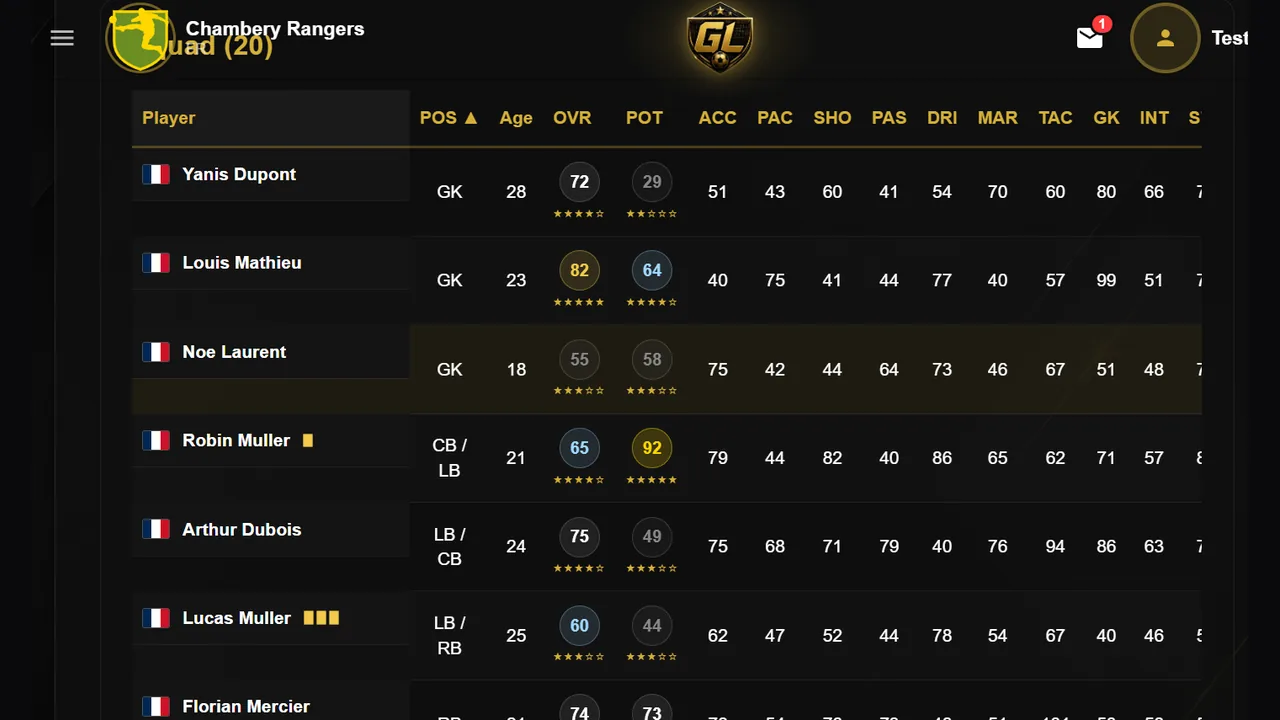
None of these three states stop you from opening the squad screen, but a player who's injured, suspended, or short on fitness simply won't be selectable when you build the matchday XI on the lineup and formation screen. A staged lineup or planned substitution set up in advance through lineup planning gets checked again right before the match simulates, so an injury or suspension picked up after you set one won't sneak an unavailable player onto the pitch.
A player's career page keeps a running count of appearances, goals, assists, cards and clean sheets, both for their whole career and broken out by the current season, so a player's disciplinary record is never hidden, it's just sitting alongside the rest of their stats rather than called out on its own. Injury status shows an expected return date rather than a vague "day-to-day" label, and a suspended player shows how many matches are left to serve, so you're never guessing at when either one clears.