
The Transfer Market Explained
Every transfer in Goal Legends happens one of two ways: a public listing that any manager can bid on, or a private offer sent directly to another manager for a player who was never listed at all. Both end with a player changing clubs. How each one gets there is different, and it helps to know the mechanics before you're in the middle of one.
Listing a player
When you list a player, the game takes a snapshot of that player's current market value at the exact moment you create the listing. That snapshot doesn't move again for the life of the listing, even if the player's underlying value drifts up or down afterward, and it's what everything else on the listing gets measured against.
You set a minimum price on every listing, and optionally a separate buy-now price on top of it. Both have to fall somewhere between 75% and 300% of the snapshotted value, no exceptions. That range exists so a listing can't be priced absurdly low or absurdly high relative to what the game already thinks the player is worth at the moment you list them, whichever direction you're tempted to push it.
The minimum price and the buy-now price do different jobs. The minimum is the floor a bid has to clear to be accepted at all. The buy-now price, if you set one, is a separate shortcut sitting above that floor: any manager who meets it outright ends the listing immediately rather than waiting for it to run its course. A listing doesn't need a buy-now price to function, it's entirely optional on top of the minimum.
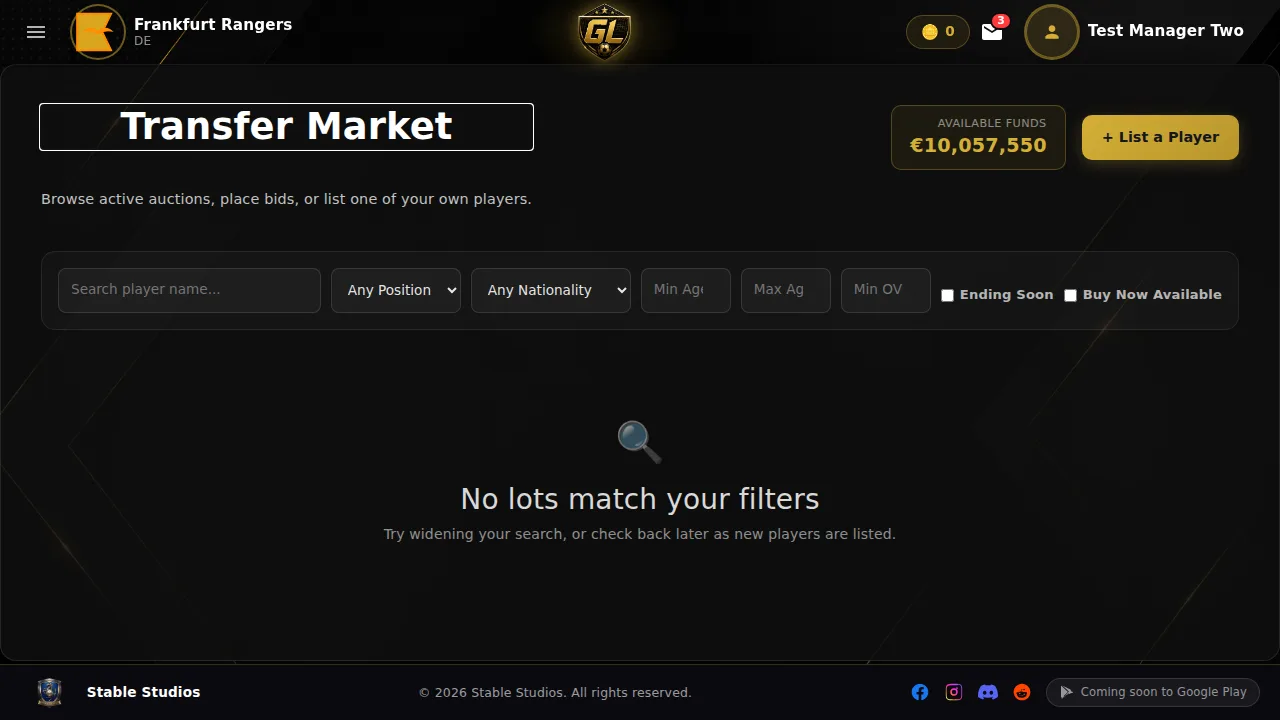
Bidding, and why waiting doesn't work
Once a listing is live, other managers place bids on it, and only one bid is ever the current winning bid at a time. If you're outbid, your bid simply stops being the leading one, it doesn't disappear from the listing's history, and you're free to bid again if you want back in.
Some bids are tagged as bot bids, so it's always visible when you're bidding against the game's own AI-controlled clubs rather than another human manager. That tag doesn't change anything about how the bid itself is handled, it's just transparency about who put it in.
There's also an anti-snipe rule built into every listing: any qualifying bid placed in the closing stretch pushes the listing's expiry forward by a fresh hour. That resets each time it triggers, so a listing genuinely can't be won just by holding off and dropping a bid in the last second. Whoever's leading when time actually runs out with no further bids coming in is the one who wins it.
Where your money goes when you bid
Placing a bid isn't just a promise, it locks funds immediately. The moment you bid, that money is reserved against your club's balance, and your actual spendable balance at any point is your raw balance minus everything currently tied up in open bids. That's what stops a manager from placing four bids with the same pool of money and hoping only one of them lands. If you're outbid, or the listing closes or gets cancelled, the reservation is released automatically and the money is yours to use again. This sits on top of the same club balance covered in Club Finances Explained, it's not a separate transfer budget.
Private offers
Not every deal starts with a listing. A private offer is an unsolicited bid sent directly to another human manager for a player who isn't on the market at all, for example someone you've identified through scouting. This route only works on players owned by another human manager, it doesn't apply to the game's own AI-run clubs.
The receiving manager can accept or ignore it. If they accept, the player still doesn't move straight away. Accepting spins up a real public listing that runs for 48 hours, so other managers get a genuine chance to bid on it before the deal is actually final. A private offer is really a way of starting a listing on a specific player rather than a way of skipping the market entirely.