
How Matches Are Simulated
Nobody clicks a button and watches your match happen. Every fixture in Goal Legends plays itself out on the game's own schedule, decided entirely by what you put in place beforehand. Here's what that actually means in practice.
Not two ratings compared
A lot of management games settle a result by weighing one team's overall rating against the other's and rolling some dice around the gap. Goal Legends doesn't do that. Each match is played out possession by possession, 180 of them from kickoff to full time, and every one is worked out on its own. That's slower to build and there's no shortcut in it, but it means the shape you picked and the players you put on the pitch are actually present in the result, not just implied by a number that got compared once.
This applies to every fixture the same way, whether it's a title-deciding league match, a cup tie, or a friendly you arranged yourself for a quiet week. The engine doesn't know or care what the match is worth. It just plays what's in front of it, possession by possession, and the result comes out the other end.
It happens on a real clock
Every fixture has a scheduled kickoff time, and the game world doesn't wait for you to be online for it. Log in a day later and the match already happened, with a full result and a report waiting for you. Log in five minutes before kickoff and nothing changes about how it plays out. There's no advantage to sitting at your screen refreshing a match, and no penalty for being asleep when your club plays. The simulation runs on its own regardless, checking the calendar on a short cycle and kicking off anything whose time has come. See Fixtures & Friendlies for how that calendar actually gets built.
Preparation is the whole game
Because nothing can be changed once a match starts, everything has to be decided before it does. Your lineup, your tactical settings, and any planned substitutions all have to be set ahead of kickoff, because there is no way to reach into a match once it has begun and adjust any of them. If your captain gets injured in the fortieth minute, whatever substitution plan you left in place is what responds to that, not a decision you get to make in the moment. That sounds strict written down, but it's really just a shift in when the decisions happen: rather than reacting live, you're reacting to how the last match actually went before you set up the next one.
What you get afterward
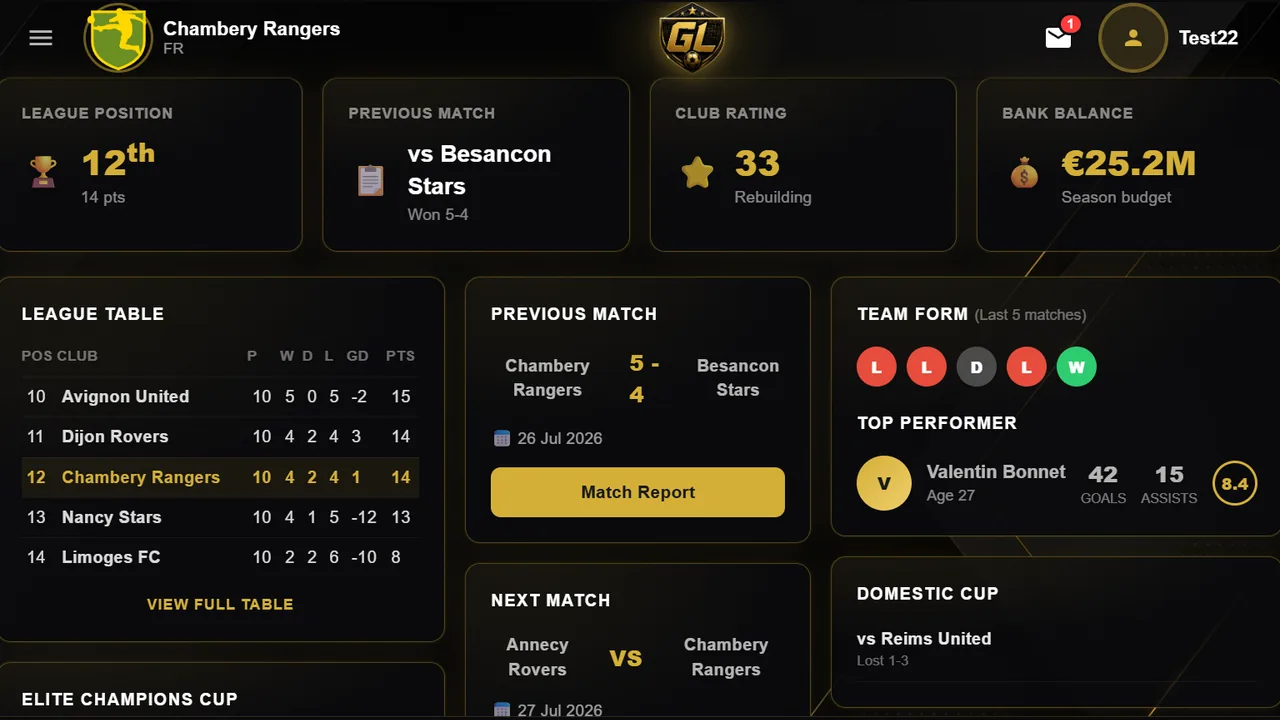
For a league match or a friendly, the final score isn't the whole story. The events generated during the simulation get turned into a match report you can go back and read: goals, cards, substitutions, the run of the game rather than a single number. If a result surprises you, that report is the place to actually look and see what happened, rather than guessing from the scoreline alone.
Domestic Cup and Elite Champions Cup matches are simulated the same way but currently only keep the final score, not a replayable event-by-event report. Worth knowing plainly rather than discovering by accident: a cup run is just as real as a league season, it's only the after-the-fact write-up that isn't there yet for those two competitions.